The New DJI Mini 5 Pro Review – AeroTech Services MRO Department
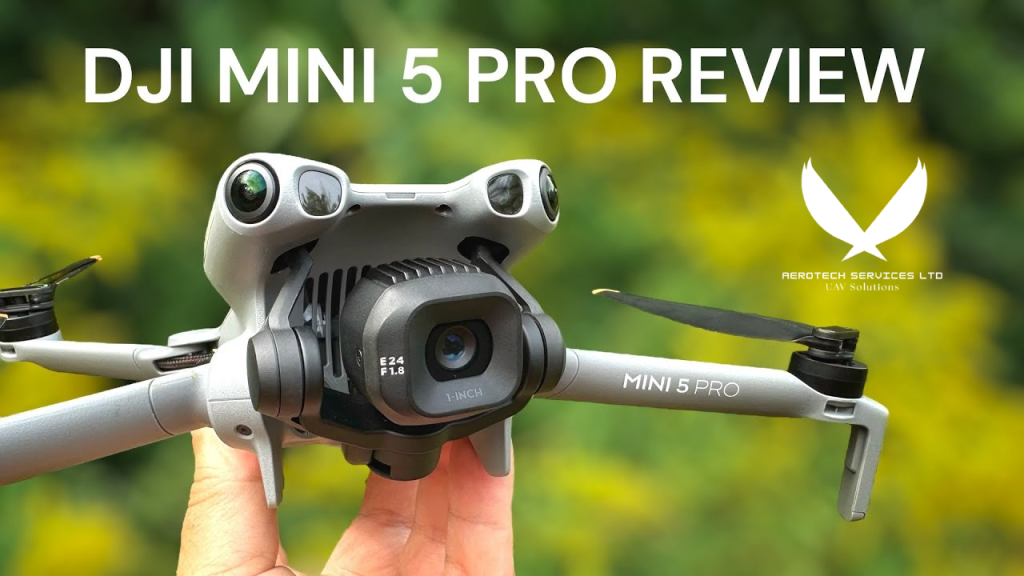
Who does not need a DJI Mini 5 Pro Review? In one of our last posts, we discussed how to discuss your next drone. The release of any new flagship model from DJI is always met with fanfare, focusing on camera resolution, flight time, and obstacle avoidance. However, for professional operators in Nigeria—from the Niger Delta to the bustling cityscapes of Lagos—the real question isn’t how well a drone flies straight out of the box, but how well it holds up after 1,000 flight hours, three minor incidents, and six trips to the repair bay.
At AeroTech Services Ltd., our Maintenance, Repair, and Overhaul (MRO) department sees past the marketing gloss. We scrutinize the build quality, the ease of component access, and the engineering decisions that dictate your drone’s long-term cost of ownership. Our review of the new DJI Mini 5 Pro is focused entirely on its resilience and repairability—the true measures of a professional tool.
DJI Mini 5 Pro Review
Section 1: The MRO Perspective on Durability and Field Readiness
The Mini series has historically been designed with portability over pure ruggedness. However, the Mini 5 Pro shows significant structural improvements designed to withstand the operational realities of demanding environments. The new frame appears to utilize a denser, reinforced polymer mix, particularly around the motor arms and chassis core.
The Frame and Environmental Resilience
One of the first things we look for is the potential for dust ingress, especially crucial during the Hamattan season. The Mini 5 Pro features tighter component integration, particularly where the shell meets the main body, which should help mitigate the microscopic sand and dust common in the operating environment.
Engineer Wilfred, one of our leading MRO specialists, noted a key improvement in the stress distribution of the arms:
“In previous Mini models, we saw stress fractures originating from the hinge mechanism after hard landings—even relatively minor ones. The Mini 5 Pro’s hinges are reinforced, and the folding mechanism feels more substantial. Crucially, the internal wiring channels are slightly more isolated. This is a huge win for field operators who cannot afford frequent frame replacements or intermittent wiring issues.”
In this DJI Mini 5 Pro Review, we like to maintain that, while the drone remains light (keeping it under the 250g classification in many jurisdictions), the strategic thickening of the critical load-bearing points suggests DJI listened to maintenance feedback regarding durability under stress.
Section 2: Repairability: The True Measure of Professional Grade
The cost of a drone is negligible compared to the cost of downtime. Our MRO analysis focuses heavily on modularity—how quickly and affordably we can swap out the most common failure points.
Motor and ESC Accessibility
Motors are consumables, especially in dusty regions where bearings wear quickly. Accessing and replacing the Mini 5 Pro’s brushless motors is streamlined compared to its predecessors. They remain mounted via small screws, allowing for component isolation without requiring the complete dismantling of the main shell—a major time-saver in the repair bay.
The Electronic Speed Controllers (ESCs) appear to be better integrated into the main board but with more defined connection points. Engineer Demola, who specializes in power systems, highlighted the improved battery connector housing:
“The battery compartment on the Mini 5 Pro is robust. The new connector design minimizes lateral stress on the pins during repeated insertion, reducing the likelihood of intermittent power faults we often had to fix on the Mini 3/4 series. Furthermore, the intelligent flight battery interface is now easier to clean, which is essential for dust control.”
The Gimbal Assembly: A Critical Vulnerability
The gimbal remains the single most vulnerable and complex subsystem to repair. DJI has made strides in making the gimbal modular: the entire assembly can be detached with fewer screws and connector points than previous generations. This means that a gimbal replacement (the most common repair after a side impact) can be executed faster, cutting down labor costs for the client.
However, one persistent challenge remains: the ribbon cable vulnerability. While slightly better protected by a stronger plastic housing, the flexible ribbon cable connecting the camera to the main board remains delicate. Our advice to operators remains the same: treat the gimbal with extreme caution during transport.
Section 3: Essential Component Deep Dive for MRO

The New DJI Mini 5 Pro Expert Review
1. Cooling and Thermal Management
Professional missions in high-temperature environments (common across Nigeria) generate significant heat, stressing the Flight Controller (FC) and the Video Transmission (VT) system. The Mini 5 Pro features enlarged passive ventilation slots located optimally beneath the main FC stack.
Engineer Wilfred confirms that while the drone is compact, the new airflow design is superior:
“The improved airflow management should reduce the incidence of thermal throttling, which can cause sudden performance degradation during long-range flights or prolonged hovering. Better cooling means better longevity for the sensitive processors.”
2. Vision Sensors and Obstacle Avoidance
The obstacle avoidance sensors are now more recessed into the body, offering better protection from glancing impacts. However, sensor replacement still requires careful re-calibration using specialized factory jigs. This underscores the need for operators to use professional, certified MRO services like AeroTech Services Ltd. when dealing with sensor faults, as improper calibration can lead to catastrophic failure.
The New DJI Mini 5 Pro Expert Review
3. Spare Parts and Serviceability
A significant advantage of the DJI ecosystem is the availability of genuine spare parts. Our partnership ensures we have access to the specific, high-quality components needed for the Mini 5 Pro. From the bespoke landing gear assemblies to the calibrated IMU chips, the ability to source genuine parts locally is the ultimate assurance of long-term airworthiness.
When a professional tool breaks, the question isn’t “Can it be fixed?” but “Can it be fixed right, quickly, and without compromising safety?” The Mini 5 Pro’s design facilitates professional repair, but it still requires the precision tools and expertise that only a certified service center can provide.
MRO Verdict: An Investment Worth Protecting
The DJI Mini 5 Pro is a powerful, capable drone. More importantly, its design evolution shows a clear trend towards improved repairability and ruggedness for the professional market. This reduces the total cost of ownership over its lifespan, making it a sound investment.
However, even the best-designed drone requires expert care. Don’t wait for a crash to find out if your internal components have drifted. Take advantage of our end-of-year savings to ensure your Mini 5 Pro (or any other drone in your fleet) is perfectly tuned.
The New DJI Mini 5 Pro Expert Review