Maximizing Uptime: How Aerotech Services Minimizes Shutdowns and Production Loss
The Niger Delta region serves as the heartbeat of Nigeria’s oil and gas activities, a sector that remains the primary driver of national revenue and economic growth. For industry stakeholders, Maximizing Uptime is not just an operational goal but a national necessity, as the country’s economic stability is intrinsically linked to its production capacity. Despite years of systemic challenges that have historically crippled output, the industry is finally witnessing a shift toward more resilient and continuous operations.
According to a September 2025 report from the Nigerian Upstream Petroleum Regulatory Commission (NUPRC), daily crude oil losses have plummeted to between 9,600 and 8,500 barrels per day—a significant recovery compared to the staggering losses of previous years. This progress marks a vital step in Maximizing Uptime across the value chain, reversing the damaging trend seen between 2016 and 2021 when annual cumulative losses soared from 20.7 million to 37.6 million barrels. By minimizing these shutdowns, the industry is directly safeguarding critical sectors like transportation and food supply, ensuring a more stable economic future for the nation.
.
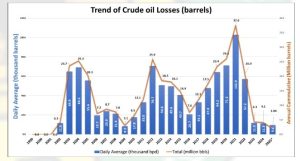
Trend of Crude oil Losses via NUPRC
The recent decline in losses demonstrates that advances in technology, coupled with effective implementation, can play a significant role in addressing long-standing national challenges. Current figures indicate that crude oil losses have dropped to approximately 2.04 barrels per day. For the period ending July 2025, this represented a dramatic 94.57% reduction compared to the full year of 2021, when Nigeria recorded losses of 37.6 million barrels, equivalent to a daily average of 102,900 barrels.
The oil and gas industry is one of the key sectors served by Aerotech Services Limited. Operations within this industry often involve processes and operating conditions that can lead to shutdowns or production losses. These losses arise from a range of factors, which will be examined in subsequent sections. As an active contributor within the sector, Aerotech Services Limited has played a role in supporting this national progress by deploying innovative solutions aimed at minimizing shutdowns and reducing production losses.
Firstly, it is important to examine the primary causes of shutdowns and production losses within the Nigerian oil and gas industry. These disruptions typically arise from a combination of operational challenges, equipment failures, external influences, and human error. Shutdowns may be planned, such as those conducted for scheduled maintenance, or unplanned, resulting from emergencies. Unplanned shutdowns are particularly costly and pose significant safety risks.
Asset integrity inspections across refineries, Floating Production Storage and Offloading units (FPSOs), flare stacks, storage tanks, and pipeline networks are mandatory regulatory requirements. Despite this, several persistent issues continue to drive production losses and operational shutdowns, often costing operators millions of dollars per day in deferred output.
Key contributing factors include the following:
- Mandatory Shutdowns:
Activities such as live flare inspections and confined space entries frequently require partial or full shutdowns lasting several days or even weeks. Additionally, the detection and localization of pipeline leaks or faulty valves can be time-consuming due to the resources, access constraints, and human capital required. These factors often necessitate mandatory facility shutdowns to ensure safety and regulatory compliance. - Vandalism and Theft:
Pipeline breaches, wellhead detonations, and deliberate crude oil sabotage, particularly prevalent in the Niger Delta, result in spills, environmental damage, and forced shutdowns. Due to their frequency, these incidents represent one of the most significant contributors to sustained production losses. - Harsh Terrain and Extreme Weather Conditions:
Offshore installations and remote onshore locations present logistical challenges that limit access and delay emergency response, thereby extending downtime. Furthermore, extreme heat, high humidity, and seasonal flooding can cause equipment malfunctions and structural stress, occasionally necessitating complete operational shutdowns. - Safety Risks:
Manual inspections involving human entry into hazardous environments increase the likelihood of incidents that can trigger operational stoppages. High-risk activities such as confined space entry, scaffolding, rope access, and manned surveys require extensive preparation and carry elevated safety risks, often leading to costly delays. - Equipment Failure:
Equipment failure remains a leading cause of shutdowns, commonly resulting from aging infrastructure, corrosion, and mechanical breakdowns. Critical components such as pumps, pipelines, valves, and control systems are particularly vulnerable, with failures often intensified by harsh operating conditions.
Given the scale of these challenges and their impact on sectoral growth, addressing them is critical to the sustainable development of Nigeria’s oil and gas industry. The following section outlines how Aerotech Services Limited is actively supporting this development by delivering innovative solutions designed to minimize shutdowns and reduce production losses.
Aerotech Services Limited delivers tailored Unmanned Aerial Vehicle (UAV) solutions through a diverse fleet of drones designed for long-endurance Vertical Take-Off and Landing (VTOL) operations, high-resolution imaging, precision landing, specialized payload integration, and autonomous flight missions. We understand the operational challenges faced by industry operators in maintaining continuous situational awareness, acquiring actionable data, and minimizing downtime. Leveraging the inherent advantages of drone technology, such as aerodynamic efficiency, compact design, unmanned operation, and cost effectiveness, we provide reliable aerial solutions that deliver measurable operational value.
To address these challenges, Aerotech Services Limited offers the following specialized services:
- Live and Remote Inspections:
Deployment of drones equipped with high-zoom optical and thermal imaging payloads for the inspection of flare stacks and elevated structures, enabling detailed assessments without requiring operational shutdowns. - Confined Space Surveys:
Use of collision-tolerant drones for inspections of tanks, vessels, and pressurized equipment, eliminating the need for human entry and significantly reducing safety risks. - Pipeline and Asset Surveillance:
Operation of High-Altitude Long Endurance (HALE) drones for aerial monitoring to detect encroachment, leaks, and acts of vandalism across pipeline networks and critical infrastructure. - Maintenance and Training:
Comprehensive drone fleet maintenance and servicing delivered by skilled, NCAA-certified engineers to ensure high system availability. In addition, Aerotech provides structured drone pilot training programs to support safe and effective operations. - Consultancy Services:
Strategic advisory support focused on optimizing drone integration to enhance operational efficiency and decision-making.
These services have delivered significant value to clients within the oil and gas sector, particularly in reducing shutdowns and minimizing production losses. Aerotech’s drone deployments across the Niger Delta region have enabled the following outcomes:
- Live Asset Monitoring:
Over 600 flight hours dedicated to the remote inspection of flare stacks, pipelines, flow stations, wellheads, and offshore platforms, helping to reduce production interruptions and mitigate crude oil theft. - Rapid Response Capability:
A dedicated rapid-response team of multi-rotor drone pilots and engineers enables swift deployment for anomaly detection, such as corrosion or leaks, preventing escalation into unplanned shutdowns. - Data-Driven Insights:
Advanced payloads generate high-resolution imagery, thermal data, and 3D models that support predictive maintenance strategies, improve asset condition monitoring, and extend service life. - Enhanced Safety:
Drone-based inspections significantly reduce personnel exposure to hazardous environments, including heights, toxic atmospheres, and confined spaces, thereby minimizing incident-related stoppages. - Operational Efficiency Gains:
Unmanned Aerial Systems enable inspections to be completed within hours rather than days, while allowing for frequent, non-intrusive assessments that improve overall operational efficiency.
The Nigerian oil and gas industry is benefiting significantly from the adoption of drone technology, which continues to transform operational practices across the sector. Key areas of impact include:
- Uptime Maximization:
Reduced or eliminated shutdowns enable operators to sustain full production capacity and avoid deferred output. - Cost Savings:
The diminished reliance on scaffolding, vessel mobilization, and large inspection teams, combined with lower losses per barrel per day, has translated into measurable improvements in operational efficiency and revenue. - Regulatory Compliance:
Frequent, well-documented inspections can be conducted safely and efficiently, supporting compliance with regulatory requirements while minimizing operational disruption. - Environmental Protection:
Early detection of leaks and anomalies limits environmental incidents, reduces spill-related liabilities, and minimizes regulatory penalties.
Operators partnering with Aerotech Services Limited report enhanced operational resilience despite the complexities of Nigeria’s operating environment. These improvements have contributed to an estimated 33% increase in production efficiency recorded across the sector in recent years.
Looking ahead, GlobalData projects that by 2030, approximately 90% of oil and gas companies worldwide will rely on drone technology for inspection and surveillance activities. This projection underscores the urgency for operators to proactively embrace drone-enabled solutions and develop effective integration strategies.
Aerotech Services Limited is at the forefront of this transformation, pioneering the use of drone technology to maximize uptime within Nigeria’s oil and gas sector. By transitioning from disruptive, traditional inspection methods to efficient and safe aerial solutions, Aerotech helps operators minimize shutdowns, safeguard revenue, and align operations with industry objectives for sustainability and safety.
Accordingly, oil and gas operators are encouraged to:
- Leverage Aerotech Services Limited’s consultancy services for tailored drone integration strategies
- Utilize Aerotech’s maintenance capabilities to ensure sustained fleet reliability
- Engage Aerotech for real-time, comprehensive asset monitoring and coverage
- Explore Aerotech’s full suite of drone-enabled solutions to support operational excellence