Traditional Helicopter Patrols Surveillance Vs Drone Surveillance for pipeline monitoring
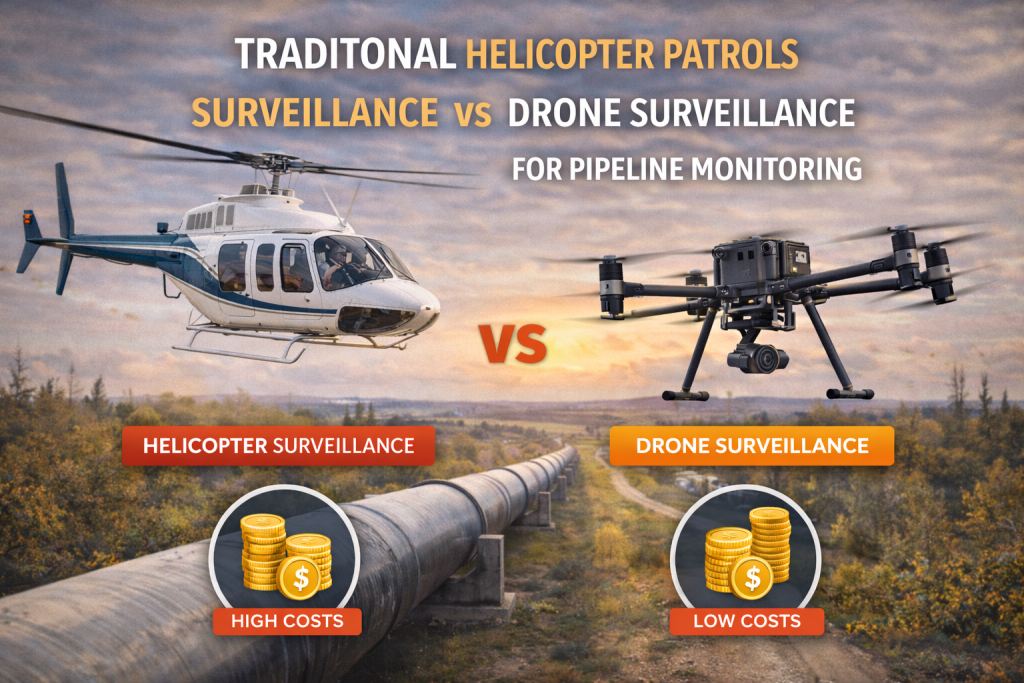
Drone surveillance for pipeline monitoring is rapidly transforming how oil and gas companies protect critical infrastructure. Pipeline surveillance is a vital operational activity across the energy sector, especially in regions where pipelines stretch across remote forests, rivers, farmlands, deserts, and populated communities. These assets face constant risks, including leaks, vandalism, encroachment, erosion, illegal tapping, and third-party interference.
Traditionally, helicopter patrols have been the primary method for aerial pipeline inspection. Helicopters offered speed, visibility, and long-range coverage, making them suitable for large-scale monitoring. However, advancements in drone technology, automation, artificial intelligence, and remote sensing have introduced a more efficient, safer, and cost-effective solution: automated drone surveillance systems.
Traditional Surveillance vs. Drone Surveillance for Pipeline Monitoring
As the industry moves toward digital transformation, companies are now evaluating which method delivers better value, performance, and sustainability. This article provides a detailed comparison of drone surveillance and traditional helicopter patrols for pipeline monitoring operations.
1. Coverage and Inspection Frequency
Helicopter Patrols
Helicopters are capable of covering long pipeline distances within short timeframes, making them effective for extensive networks that span hundreds of kilometers. However, their high operational costs significantly limit inspection frequency. Most helicopter patrols are scheduled weekly, biweekly, or monthly due to budget constraints.
This creates long inspection gaps where leaks, tampering, or environmental damage can go undetected for days or weeks, increasing financial, environmental, and safety risks.
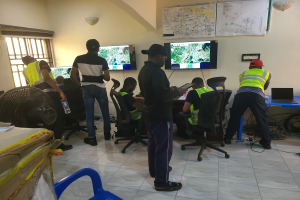
AeroTech Services Ltd Pipeline Surveillance and Live streaming Station
Drone Surveillance
Drones now offer long-range capabilities through BVLOS (Beyond Visual Line of Sight) operations, allowing them to monitor extended pipeline routes without constant visual contact from operators. Unlike helicopters, drones can be deployed frequently — even daily — because they require fewer resources and lower operational costs.
This high-frequency inspection model enables early detection, faster intervention, and proactive asset protection instead of reactive damage control.
2. Cost Efficiency
Helicopter surveillance comes with heavy financial burdens, while even a single patrol flight can consume a large operational budget, making routine monitoring financially unsustainable over time.
| Factor | Traditional Helicopter Patrols | Drone Surveillance |
|---|---|---|
| Energy Source | Aviation fuel | Battery-powered |
| Personnel | Pilot + crew required | Few operators needed |
| Maintenance | High maintenance costs | Low maintenance costs |
| Storage | Hangars and aviation facilities | Minimal storage needs |
| Insurance | Very expensive aviation insurance | Lower insurance costs |
| Deployment Logistics | Complex planning and logistics | Fast and flexible deployment |
| Overall Cost Impact | Very expensive for routine monitoring | 50%–80% cheaper over time |
Over time, organizations can achieve 50%–80% cost savings using drones, depending on terrain, mission scope, and operational scale. This makes continuous monitoring financially viable instead of episodic surveillance.
3. Safety and Risk Exposure
Helicopter Patrols
Helicopters are high-risk aviation assets. Low-altitude patrols expose crews to:
-
Harsh weather conditions
-
Mechanical failure risks
-
Terrain hazards
-
Powerline and tower collisions
-
Emergency landing challenges
While helicopter accidents are statistically rare, they often result in severe injuries or fatalities when they occur, making safety a constant concern for operators and regulators.
Drone Surveillance
Drone systems remove humans from aerial risk entirely. Operators remain safely on the ground while drones perform inspection tasks. This dramatically improves Health, Safety, and Environment (HSE) performance, reduces liability exposure, and aligns with corporate safety policies and regulatory compliance frameworks.
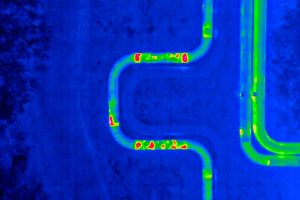
Gas leakage detection by the AeroTech Services Ltd’s drone
4. Quality of Inspection Data
Traditional patrols rely heavily on visual observation. Although helicopters can carry cameras, inspection quality is often limited. Also, close-range inspection increases risk and operational complexity.
| Factor | Traditional Helicopter Patrols | Drone Surveillance |
|---|---|---|
| Image Quality | Limited by speed, altitude, vibration | High-resolution imagery |
| Video Quality | Basic aerial video | 4K ultra-HD video |
| Inspection Distance | Far-range visual observation | Close-range inspection |
| Hovering Capability | Risky at low altitude | Safe precision hovering |
| Sensor Support | Limited sensor integration | Thermal, LiDAR, multispectral |
| Data Consistency | Inconsistent | Highly repeatable and standardized |
| Analytics Use | Mostly manual interpretation | AI-powered data analysis |
Drones can hover at safe altitudes, perform detailed inspections, and generate consistent datasets that support trend analysis, predictive maintenance, and long-term asset monitoring.
5. Response Time During Emergencies
Helicopter emergency response depends on several variables. This can delay deployment during critical incidents.
| Factor | Traditional Helicopter Patrols | Drone Surveillance |
|---|---|---|
| Deployment Speed | Dependent on crew and readiness | Near-instant deployment |
| Launch Locations | Airports and helipads | Mobile units, stations, vehicles |
| Operational Readiness | Requires preparation time | Rapid activation |
| Live Monitoring | Limited real-time transmission | Real-time live streaming |
| Situational Awareness | Delayed assessment | Immediate visual intelligence |
| Emergency Accessibility | Restricted by infrastructure | Accessible from remote locations |
Drones, on the other hand, can be launched immediately from mobile response vehicles, pipeline stations, etc. They provide real-time video streaming, live situational awareness, and instant damage assessment, enabling faster response, containment, and decision-making during emergencies.
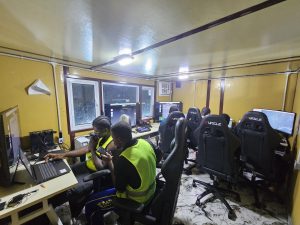
One of AeroTech Services Ltd Drone Live streaming stations for Pipeline surveillance
6. Automation and Data Integration
| Factor | Traditional Helicopter Patrols | Drone Surveillance |
|---|---|---|
| Flight Operations | Fully manual | Automated flight routes |
| Data Collection | Human observation-based | Sensor-based digital capture |
| Reporting System | Manual reports | Automated reporting |
| AI Integration | Not supported | AI anomaly detection |
| GIS Integration | Limited | Full GIS integration |
| Predictive Capabilities | Reactive approach | Predictive maintenance |
| Digital Systems | Standalone operations | Fully integrated digital ecosystem |
Helicopter inspections remain largely manual, and this approach increases the risk of human error, inconsistent reporting, and data loss. This is not the same as drones. Drone systems enable full digital transformation. This creates a smart pipeline surveillance ecosystem that is not just reactive, but predictive and preventive.
7. Limitations and Challenges
| Category | Traditional Helicopter Patrols | Drone Surveillance |
|---|---|---|
| Regulatory Barriers | Aviation regulations | BVLOS approvals |
| Operational Cost | Extremely high | Low to moderate |
| Safety Risk | High human risk | Minimal human risk |
| Environmental Impact | High carbon emissions | Low emissions |
| Technical Constraints | Pilot dependency | Battery life limits |
| Workforce Needs | Specialized pilots | Trained drone operators |
| Infrastructure | Heavy infrastructure needs | Light infrastructure needs |
| Cybersecurity | Low digital risk | High data security needs |
| Weather Impact | High | Moderate |
While drones offer superior advantages, helicopters may still be useful in specific scenarios, such as ultra-long-distance coverage or heavy-payload missions, where drone regulations remain restrictive.
Conclusion
Automated drone surveillance is rapidly redefining pipeline monitoring across the oil and gas industry. Compared to traditional helicopter patrols, drones deliver:
Key Advantages
-
Lower operational costs
-
Higher safety standards
-
Superior data quality
-
More frequent inspections
-
Faster emergency response
-
AI and automation integration
-
Digital asset management compatibility
Helicopter Patrols Remain Useful For:
-
Extremely long-range missions
-
Regions with strict drone regulations
-
Heavy payload operations
-
Specialized emergency scenarios
The future of pipeline surveillance is clearly shifting toward a drone-first operational model, supported by AI analytics, BVLOS operations, smart infrastructure, and integrated asset management platforms. Companies that adopt this approach early will benefit from improved efficiency, reduced risk, enhanced compliance, and long-term cost optimization.

