BVLOS Pipeline Monitoring: The Future of Long-Range Surveillance
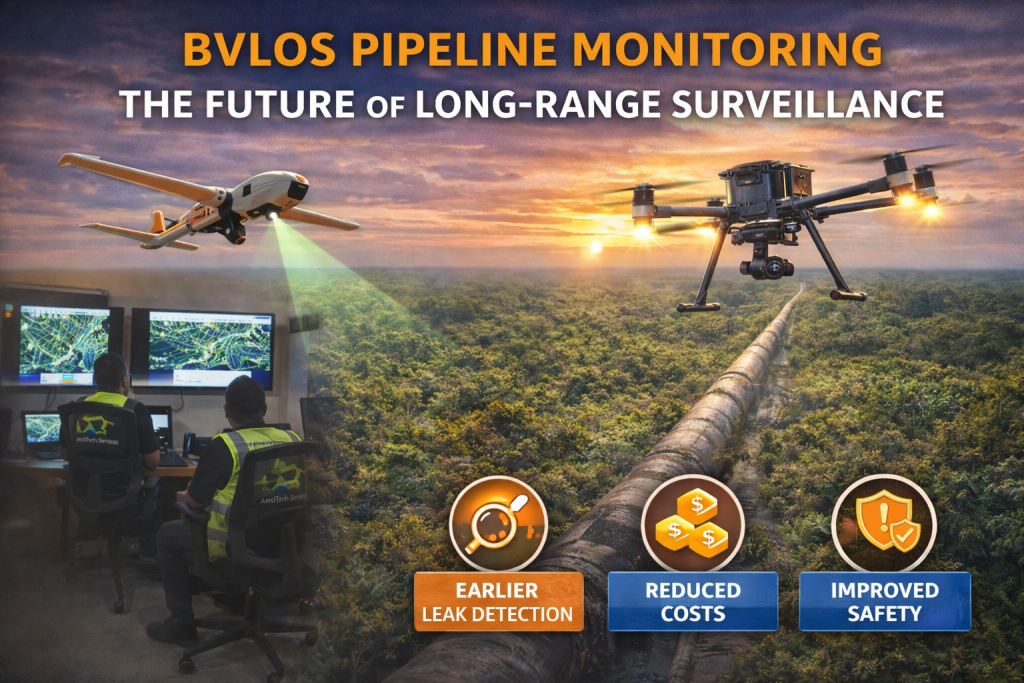
BVLOS Pipeline Monitoring is transforming how energy infrastructure is inspected and protected across vast territories. In an industry where pipelines stretch thousands of kilometers across forests, deserts, wetlands, and offshore environments, traditional monitoring methods are no longer sufficient.
For decades, pipeline operators have relied on ground patrols, manned aircraft, and fixed sensor installations. While these approaches have delivered results, they are often costly, labor-intensive, and reactive rather than preventive. In a sector where early detection can prevent environmental disasters, operational shutdowns, and reputational damage, waiting for incidents to occur is a risk few organizations can afford.
Beyond Visual Line of Sight (BVLOS) drone operations are redefining that reality. They represent not just a technological improvement, but a structural shift in how long-range pipeline surveillance is executed.
What Is BVLOS — and Why It Matters
Beyond Visual Line of Sight (BVLOS) refers to drone operations conducted outside the pilot’s unaided visual range. Unlike traditional Visual Line of Sight (VLOS) flights, BVLOS allows unmanned aircraft to travel extended distances — often tens or even hundreds of kilometers — while maintaining secure command, control, and telemetry links.
For pipeline operators, this extended range is transformative.
Pipeline corridors frequently pass through remote, inaccessible, or high-risk regions. Monitoring these assets requires endurance, real-time data, and scalable deployment — capabilities that BVLOS systems are uniquely designed to provide.
Instead of dispatching personnel into hazardous terrain or scheduling costly helicopter flyovers, operators can deploy long-endurance drones capable of covering entire pipeline sections in a single mission.
The Shortcomings of Traditional Monitoring
Historically, pipeline surveillance has involved:
-
Ground patrol teams navigating challenging terrain
-
Stationary leak detection systems placed at intervals
Each of these methods presents operational limitations:
-
High fuel and manpower costs
-
Exposure of personnel to environmental and security risks
-
Limited inspection frequency
-
Delayed identification of leaks, encroachment, or structural damage
In many cases, issues are detected only after visible damage occurs. By then, remediation costs may already be significant.
The modern energy landscape demands predictive, not reactive, monitoring systems.
How BVLOS Pipeline Monitoring Changes the Equation
1. Extended Coverage and Endurance
Fixed-wing and hybrid VTOL (Vertical Take-Off and Landing) drones designed for BVLOS missions can remain airborne for several hours. This endurance enables them to survey long pipeline corridors in a single deployment, reducing mission frequency while increasing inspection consistency.
The result is broader coverage with fewer operational interruptions.
2. Advanced Sensor Integration
BVLOS platforms are capable of carrying sophisticated payloads such as:
-
High-resolution electro-optical (EO) cameras
-
Thermal imaging systems
-
Methane and hydrocarbon gas detection sensors
-
LiDAR for terrain and structural mapping
-
Multispectral sensors for vegetation stress analysis
These technologies allow early identification of:
-
Micro-leaks and temperature anomalies
-
Soil displacement and erosion
-
Unauthorized excavation or third-party interference
-
Structural deformation
-
Vegetation stress caused by underground leaks
Detecting anomalies early reduces environmental impact, minimizes downtime, and significantly lowers repair costs.
3. Real-Time Intelligence and Analytics
Modern BVLOS systems integrate cellular, radio, and satellite communication networks to transmit live data to centralized command centers.
When combined with AI-driven analytics, the system can automatically flag anomalies in real time. Suspicious thermal signatures, pressure variations, or unexpected corridor activity can trigger immediate alerts, allowing rapid response teams to intervene before escalation.
This evolution shifts pipeline oversight from periodic inspection to continuous intelligence gathering.
4. Enhanced Safety and Risk Mitigation
Replacing manned patrol flights and minimizing ground deployment significantly reduces exposure to hazardous environments. Remote monitoring protects personnel from extreme terrain, weather conditions, and security-sensitive areas.
In addition to improving safety outcomes, this approach strengthens operational resilience.
Regulatory and Technical Considerations
BVLOS operations require regulatory approval and robust safety frameworks. Civil aviation authorities mandate risk assessments that include:
-
Detect-and-avoid systems
-
Redundant communication links
-
Fail-safe navigation protocols
-
Comprehensive operational risk management
While technical challenges such as long-distance communication reliability and power management in remote regions exist, advancements in satellite connectivity, hydrogen propulsion systems, and autonomous navigation continue to expand BVLOS feasibility.
As regulatory frameworks mature globally, BVLOS operations are steadily moving from special authorization to mainstream acceptance.
The Strategic Value for Pipeline Operators
Investing in BVLOS Pipeline Monitoring provides measurable strategic advantages:
-
Earlier leak detection and environmental protection
-
Reduced long-term surveillance costs
-
Faster emergency response capability
-
Enhanced regulatory compliance documentation
-
Continuous corridor visibility
In an era defined by ESG expectations, operational transparency, and cost optimization, BVLOS aligns directly with the priorities of forward-thinking energy companies.
Organizations that adopt early position themselves for greater efficiency and competitive advantage.
The Road Ahead: Autonomous Corridor Intelligence
The future of pipeline surveillance will likely include:
-
Autonomous fleet coordination
-
Swarm-based inspection missions
-
On-board edge computing for real-time data processing
-
Integration with digital twin infrastructure models
-
Fully remote operations centers
Remember that, what is emerging is not simply improved inspection — it is a transition toward continuous, autonomous infrastructure intelligence. Pipeline monitoring is evolving from periodic observation to persistent, data-driven oversight.