Drone ROI in oil and gas: 6 Ways Drones Drive Return on Investment in the Oil and Gas Sector
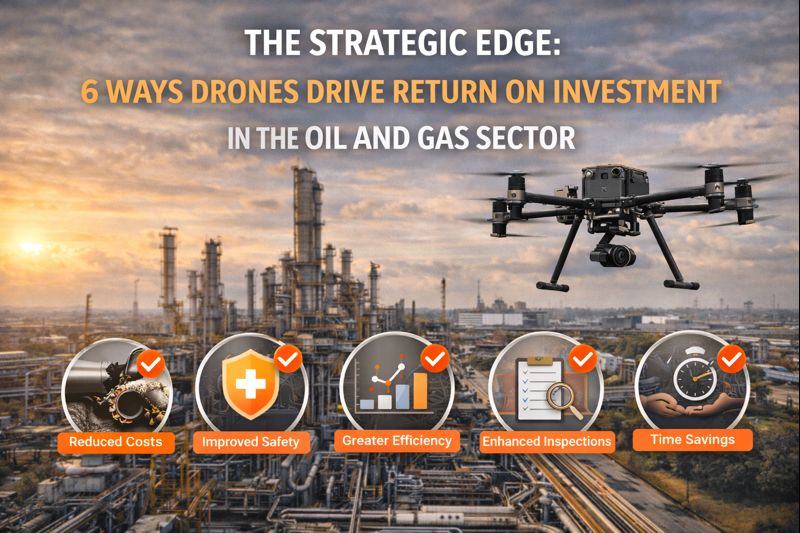
In the oil and gas (O&G) sector, achieving a significant drone ROI in oil and gas is now a reality as advanced platforms like the DJI Matrice 400 transform infrastructure management. Where vast pipelines, offshore platforms, and critical assets stretch across challenging terrains, drone technology is delivering measurable financial returns. Rather than being a luxury, drones have become a strategic asset that drives safety, efficiency, and profitability across upstream, midstream, and downstream operations.
BENEFITS OF DRONE TECHNOLOGY TO OIL & GAS COMPANIES
1. Dramatically Lower Operational Costs
Traditional inspections in the O&G industry are expensive, time-intensive, and often disruptive. They can involve shutting down production, erecting scaffolding, or deploying helicopters. Drones eliminate much of this overhead by quickly surveying facilities and flare stacks at a fraction of the cost. Studies show drone-based programs can reduce operational costs by 20–50% compared to manual methods.
2. Shorter Downtime and Faster Inspections
Downtime costs O&G companies millions daily. Using drones means inspections that once took days can now be completed in hours—often without interrupting production. This agility improves asset uptime and accelerates maintenance scheduling, allowing for continuous operations.
3. Enhanced Safety and Reduced Liability
One of the most significant ROI factors is risk reduction. Traditional inspections expose workers to hazardous environments like high structures and confined spaces. Drones perform these tasks remotely, greatly reducing the chance of accidents and lowering insurance and liability costs over time.
Video Credit: DJI
4. High-Quality Data for Better Decision-Making
The Matrice 400’s ability to carry advanced payloads—such as thermal imagers, LiDAR, and gas sensors—lets operators capture detailed structural data. This supports predictive maintenance, enabling engineers to detect corrosion or leaks early. Access to real-time data reduces unplanned failures that inflate costs.
5. Regulatory Compliance and Environmental Performance
Drone inspections support compliance by supplying precise records and imagery required for audits and environmental monitoring. In an environment focused on emissions and safety standards, drone-collected data helps companies meet requirements more cost-effectively than traditional methods.
6. Scalability and Long-Term Strategic Value
Beyond inspections, drones are being integrated into digital transformation initiatives such as creating digital twins and AI-enhanced predictive analytics. These capabilities extend the Matrice 400’s ROI into long-term strategic value, helping companies optimize maintenance cycles and allocate resources efficiently.
Conclusion on Drone ROI in oil and gas
For oil and gas companies, adopting the DJI Matrice 400 represents a clear financial win. By reducing costs, minimizing downtime, and improving safety, drone programs enhance both the bottom line and operational resilience. As technology advances, drones will remain an indispensable tool in the competitive energy landscape.

